A coding harness is the scaffolding that lets an AI model safely edit code, run tests, and manage tasks. The industry is now debating whether to build your own or go general-purpose.
Back when Agent Zero saw its first release in mid-2024, the pitch sounded almost naive: one agent, a real computer, real tools, real memory, general enough to attempt anything. The prevailing wisdom said you needed a specialized build for every workflow with LLMs.
Two years later, the industry is arguing about exactly this. Here is where we think the debate goes wrong, and what it keeps missing.
The Debate, Honestly Summarized
One camp says: general-purpose harnesses now handle the hard parts reliably. Editing files, running tests, managing long tasks. Stop maintaining your bespoke scaffolding and ride the wave.
The other camp says: my workflow is special. 3D pipelines, unusual UIs, production reliability constraints. A general tool can't know my world, so I build my own.
Both camps agree on the framing: speed versus tailored control. Pick one.
That framing is the actual mistake. The meaningful distinction is not general versus custom. It is closed versus composable and transparent.
Latent Demand Told Us Everything
There's a pattern people building on CLI harnesses kept hitting: everyone ended up writing their own orchestrator on top. A new internal wrapper every week. Anthropic's own people call this latent demand, users abusing a product until it reveals what it should have been.
Read that latent demand carefully. When your harness is a single CLI session, you are the orchestrator. The human becomes the scheduler, the router, the context manager. Every wrapper someone builds is a complaint filed against the harness.
The major harnesses have since responded. Claude Code added subagents with separate contexts. Codex grew from a CLI into a desktop app with parallel agents and diff review. Good. That direction is the point.
Agent Zero has had native orchestration since the early releases: the agent spawns subordinates with dedicated contexts, assigns focused subtasks, runs them in parallel, and synthesizes the results. Different models for different roles, a strong reasoner on architecture, a fast model on grunt work, in one conversation and one UI. The honest claim is not that others still can't do this. It is that Agent Zero adopted these ideas early and still offers an unusually open implementation of them, where every part of the orchestration machinery is completely replaceable. Not just prompts or workflows.
Agents Are New Hires With Amnesia
The best mental model in this whole discussion: agents are like new hires in a constant state of amnesia. Capable, teachable, and unable to remember anything you told them yesterday.
A harness's real job is to compensate. You need four surfaces:
- Rules: how work gets done here. Agent Zero's prompts are plain files you can read and edit. AGENTS.md is native.
- Skills: packaged workflows the agent triggers itself when the task calls for them. Shipped in October 2024 as Instruments.
- Tools: a real Linux workstation, not a wrapper of your machine. Terminal, filesystem, browser, desktop.
- Memory: persistent, searchable, surviving across sessions and compactions.
Most harnesses bolted these on later, one release at a time. In Agent Zero they are the skeleton. That is what "general-purpose" was always supposed to mean. Not generic. Complete.
The Control Plane Question
One more thing the industry is converging on, and it's worth stating precisely.
Trust in agents does not come from pixels. It comes from mechanisms: action previews, scoped permissions, reproducible logs, meaningful diffs, isolation, approvals, rollback. A terminal can provide many of these. A beautiful GUI can provide none of them.
The real limitation shows up at scale. Terminal interfaces are excellent for individual agent interaction, but insufficient as the only control plane for supervising multiple long-running agents. That is why every major harness is currently growing a visual supervisory layer on top of its CLI.
Agent Zero was built around that supervisory layer from the start, with the trust mechanisms wired into it. Every action streams to your screen as it happens. The live Browser surface shows the agent clicking and typing in real time. The agent runs isolated in its own Docker machine, reaching your files only through a connector you install and can revoke. Time Travel lets you branch a chat from any message and roll back. The GUI is not decoration on top of the harness. It is where supervision actually happens.
What Swappable Parts Don't Solve
Composability is the right architecture. It is not a free lunch, and pretending otherwise would repeat the same overreach this article is arguing against.
An agent with real execution power concentrates real risk. Agent Zero's own documentation is direct about this: run it isolated, mount only what it needs, review actions that touch production systems, accounts, money, or private data. Plugins are code from strangers, which is why the Plugin Hub puts an AI-driven security scan in front of installation and why the guidance remains to read the report and keep secrets out of plugin source.
Interface stability, regression testing, and operational ownership of your overrides remain your job. The framework keeps shipping fixes, including security fixes, because the hard parts are never simply solved. They are maintained.
Any harness vendor telling you otherwise is selling something.
Where This Actually Lands
The debate says AI agents are maturing into dependable workhorses by mid-2026, and the choice comes down to speed versus control.
Our position, with two years of receipts: the harness question was never "custom or general." It was "does your harness force you to choose?"
A general-purpose harness with a locked core forces the fork. A fully custom harness forces the maintenance burden, and your team quietly becomes a framework team that occasionally ships product.
There is a third category: a general substrate designed to be customized without being forked. Shared foundation, swappable parts, upstream improvements that keep flowing under your overrides.
That is not a prediction about mid-2026. That is what Agent Zero has been building since its first release.
How to Install
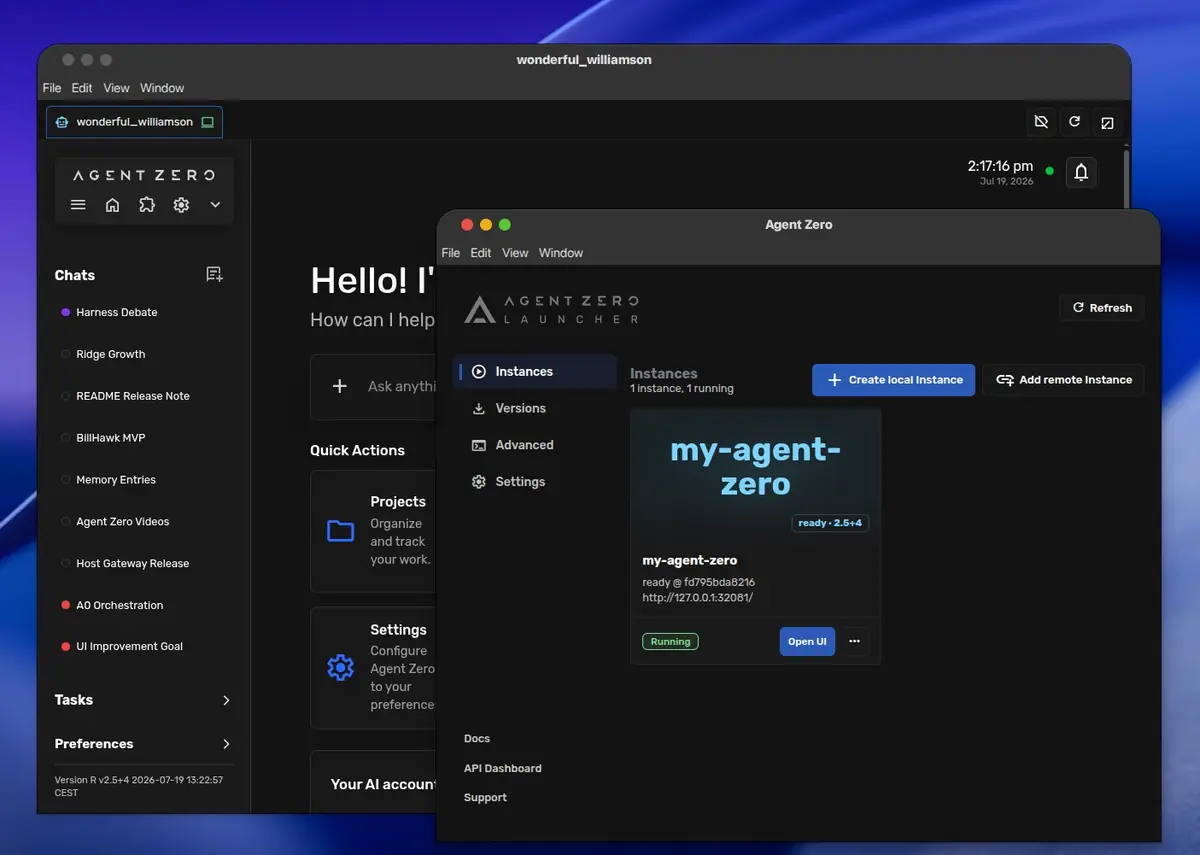
The Agent Zero Launcher is a GUI app that lets you manage both local and remote instances of A0 with peace of mind. Your agents have their own computer (as it should be), but they can interface with your machine, control it, read and write files, and use your own browser sessions and logins.
Visit agent-zero.ai and download the A0 Launcher for your platform (Windows, macOS, or Linux).
Leave a star on Agent Zero GitHub ⭐